A strategy to obtain results in the area of animal experiments must have realistic goals.
If people continue to require billions of animals to be slaughtered at the end of lives spent in the concentration-camps-like conditions of intensive farming only to satisfy humans’ taste for these animals’ flesh, which is a very trivial purpose, people are much less likely to want a ban on animal experiments which, whether successful or not, have at least in theory a more important purpose.
I suggest a 2-stages approach, which will also reconcile the endless dispute/conflict between the anti-vivisection medical versus ethical arguments.
The ethical argument requires nothing less than a total abolition of all animal experimentation, unless we are prepared to accept experimenting on humans at the same level of capacities: if we are not, then justice demands the same about non-human animals. Continuing in this double standard is pure speciesism.
Total abolition, therefore, is our final goal, long term.
But we know that it will not be realized soon.
What we can do is to set a short and medium term goal of reducing the number of animals used in research, by gradually replacing them with different methods.
This will have two benefits: saving animals and getting us nearer the final objective, because the people we want to convince here are not so much the general public and consumers (who are crucial in other campaigns such as cruelty-free products and fur coats) or the politicians, but indeed the researchers themselves. They are the ones who decide what methods to use.
If we can demonstrate to the satisfaction of researchers that the number of animals used in experiments can indeed be greatly and progressively reduced by the deploy of other techniques, we will make moves towards abolition.
In fact, we do not even need the law to be changed, in practice.
All we need is for more and more research workers to shift from an animal-centred experimental approach to an alternative-methods-centred one.
What we should be careful about doing, therefore, is about making statements that are likely to make us lose credibility.
Statements which have been made in his books by Hans Ruesch, still in many respects a great anti-vivisection author, and which one can often hear echoed by animal organizations.
In a nutshell, Ruesch says that animal experimentation has led to many medical and pharmacological disasters, has given false results and has distracted from the right path of clinical observation, the only one on which a medical science can be based.
Ergo, animal experimentation as a method is a total failure and must be abandoned.
There is a prima facie logical fallacy in this argument.
The conclusion does not follow from the premise.
The premise is not strong enough to sustain such a far-reaching conclusion.
The premise can only support the conclusion that animal experimentation is not perfect and cannot be relied on as an absolute guide.
But this premise is still compatible with a statement saying that animal experiments have a relative, limited use that can be complemented by the use of other methods at the same time.
If we take Ruesch’s own examples, even the major ones, like penicillin being fatal to guinea pigs, it’s easy to see that, after all, despite animal experimentation being the fundamental method of medical research, penicillin has been introduced, so the continued use of animal experimentation is compatible with its results being mitigated and revised in the light of other methods’ results as well.
Friday, April 07, 2006


Are cosmetics, toiletries and other household products tested on animals?

The UK stopped licensing cosmetic tests on animals in 1998, but there's no worldwide ban, and therefore the vast majority of cosmetics products sold in the UK will almost certainly have been tested on animals, even though the test will have taken place in another country.
In the United States, where many well-known cosmetics manufacturers are based, there is not even legislation in place to ensure that laboratories collate accurate statistics on the number of animals they use in cosmetics research.
Anyway, the law and animal testing bans alone are not enough to stop cosmetics companies testing on animals because they can simply shift their animal testing to a country without a ban.
This is why the most effective method of stopping this type of unnecessary cruelty is consumers pressure.
This is an area where people can make a difference. Choosing products made by companies that DO NOT test on animals and rejecting those that do test on animals is a powerful way to make your views count and produce a result.
By their buying habits, people can make companies change their policies and bring about a real end to cosmetic testing on animals.
Buy only cruelty-free products

By purchasing only cruelty-free products, you can help save rabbits, mice, guinea pigs, rats, and other animals.
Hundreds of thousands of these animals are poisoned, blinded, and killed every year in outdated product tests for shampoos, household cleaners, cosmetics, hairspray, and other personal care and household items.
Over 500 companies have banned all animal tests forever, including some major ones.
But some corporations, including Procter & Gamble, Clorox, S.C. Johnson, and others, still test on animals, by pouring toxins onto animals' shaved, abraded skin, or squirting chemicals into animals' eyes, or forcing substances into their lungs, or pumping them into their stomachs.
These archaic tests are usually not required by law, and they often produce inaccurate or misleading results. And they don't protect consumers: even if a product has blinded an animal, it can still be sold to you.
Fortunately, scientists have developed many sophisticated non-animal product tests now in use today that are faster, cheaper, and far more accurate at predicting human reactions to a product than old blinding and poisoning animal tests, which were developed in the 1920s, ever were.
Human cell cultures and tissue studies (in vitro tests) and artificial human “skin” and “eyes” mimic the body’s natural properties, and a number of computer virtual organs serve as accurate models of human body parts.
Instead of measuring how long it took a chemical to burn away the cornea of a rabbit’s eye, manufacturers could now drop that chemical onto donated human corneas. Human skin cultures could be grown and ordered for irritancy testing.
Please vow never to buy products from companies that use animals.
Draize Eye Test - eye irritancy test on rabbits for cosmetic productsThere are a broad range of animal experiments used to test cosmetics and toiletries. These are some of the most commonly used tests.
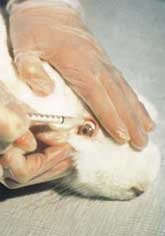
Eye irritancy
Also known as the Draize Eye Test, this is used to assess the acute irritancy of a substance when applied directly to the eye. It usually uses at least three adult albino rabbits per substance. The substance is dripped into one eye of each conscious rabbit, often immobilised in stocks for dosing, whilst the other non-tested eye serves as a control. Rabbits have far less tear flow than humans and are therefore less able to 'cry away' painful substances, which is one of the reasons why scientists use this species. Rabbits also have no blink reflex, which makes applying the chemicals easier. During the tests, damage to the eyes such as cloudiness, reddening, lid swelling, ulceration or weeping eyes is recorded over a 21 day period for a single dose. No pain relief is normally given.
Skin irritancy
Used to assess the toxicity of a substance applied to the skin. It uses at least three adult abino rabbits or guinea pigs per substance and involves applying the test substance to their shaved and abraded (scratched) back. Over hours, day or weeks, any signs of redness, swelling, inflammation, skin cracking and ulceration are recorded. No pain relief is normally given.
Acute toxicity
There are many different types of toxicity (poisoning) experiments. This one is to assess the toxic effects on the whole body of a single dose of a substance. It usually uses 15-30 rats per substance and is administered either by force-feeding (oral), injection or inhalation, usually without any pain relief. The animals are housed for a minimum of five days to 'acclimatise' before being dosed with the substance and observed for 14 days. Animals being dosed orally will be starved before testing. Symptoms include blood pressure changes, weight loss, excessive salivation, internal organ damage, breathing disturbances, convulsions, bleeding from eyes, nose or anus, pilo-erection (hair standing on end), tremors, diarrhoea, coma and even death. All the animals are killed at the end of the test for autopsy.
Cruelty free products
PETA (People for the Ethical Treatment of Animals), which, with more than 800,000 members, is the largest animal rights organization in the world and was founded in 1980, produces a "Don't Test" list of cruelty-free companies, that do not test their products on animals.
The list includes cosmetics, personal care, and household cleaning product companies only. PETA's Caring Consumer Project was founded on the fact that no law requires animal testing of these types of products, so manufacturers of these products have no excuse for animal testing and should be boycotted until they change to a non-animal-testing policy.
In order to be listed, each company has stated that it does not conduct any animal tests that are not required by law.
Companies listed either have signed PETA's statement of assurance or provided a statement verifying that they do not conduct or commission any nonrequired animal tests on ingredients, formulations, or finished products and that they pledge not to do so in the future.
The list includes cosmetics, personal care, and household cleaning product companies only. PETA's Caring Consumer Project was founded on the fact that no law requires animal testing of these types of products, so manufacturers of these products have no excuse for animal testing and should be boycotted until they change to a non-animal-testing policy.
In order to be listed, each company has stated that it does not conduct any animal tests that are not required by law.
Companies listed either have signed PETA's statement of assurance or provided a statement verifying that they do not conduct or commission any nonrequired animal tests on ingredients, formulations, or finished products and that they pledge not to do so in the future.
Wednesday, April 05, 2006
Tuesday, April 04, 2006
How much can instinct explain? An anecdote
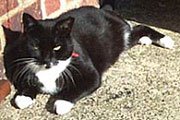
There are so many animal behaviours that cannot be explained by the simplistic view of animals acting merely by instinct.
This episode is one of them.
A cat saved a lamb from drowning in a swimming pool.
Puss Puss, a black and white female cat in Cheltenham, England, discovered that a lamb had fallen into a pool and frantically meowed, running back and forth between the pool and the garden where her human companions, gardeners Adrian Bunton and Karen Lewis, were working, to alert them to his plight.
Jill Royle, the owner of the garden, said: "She was in a very, very agitated state, meowing and calling and crying and being an utter pest and dashing back and forward between them [the gardeners] and the pool."
"They found the lamb in the swimming pool" Royle said. "They got it out and it was OK."
This was reported in the Gloucestershire Echo newspaper on 6 October 2003.
What is speciesism?
Speciesism is species-selfishness.
It is arbitrarily to give priority to the interests of our species simply because it is OUR species, in a similar way as we could give more importance to the interests of our ethnic group, social group, continent, nation, tribe, clan, family and, ultimately, ourselves.
All these are examples of selfishness which start from its simplest form, selfishness relating to the individual, and extend to groups for no other reason than because the individual is part of them.
The 19th–century historian William Edward Hartpole Lecky wrote in his History of European Morals:
“At one time the benevolent affections embrace merely the family, soon the circle expanding includes first a class, then a nation, then a colation of nations, then all humanity, and finally, its influence is felt in the dealings of man with the animal world.”
It is arbitrarily to give priority to the interests of our species simply because it is OUR species, in a similar way as we could give more importance to the interests of our ethnic group, social group, continent, nation, tribe, clan, family and, ultimately, ourselves.
All these are examples of selfishness which start from its simplest form, selfishness relating to the individual, and extend to groups for no other reason than because the individual is part of them.
The 19th–century historian William Edward Hartpole Lecky wrote in his History of European Morals:
“At one time the benevolent affections embrace merely the family, soon the circle expanding includes first a class, then a nation, then a colation of nations, then all humanity, and finally, its influence is felt in the dealings of man with the animal world.”
Monday, April 03, 2006
Animal-movement political parties
We should create a political party in all Western countries, that could be elected, having a manifesto that puts at its centre the animal agenda of issues, but also has policies on all other issues which are of concern to the electorate and which are tackled and addressed by the other parties with policies in their own manifestos.
There are 2 reasons for such creation:
1) We can rely on other parties to enact policies to protect animal rights only in a limited way.
2) On the other hand, we cannot have an animal rights party which does not address all the other issues, because it would be a fringe party, one which the majority of the electorate would not find interesting.
There are 2 reasons for such creation:
1) We can rely on other parties to enact policies to protect animal rights only in a limited way.
2) On the other hand, we cannot have an animal rights party which does not address all the other issues, because it would be a fringe party, one which the majority of the electorate would not find interesting.
Animal experiments may be less useful than alternative methods
The way the argument about usefulness of animal experimentation for medical purposes is put by its defenders is often fallacious for a very simple reason: it is on qualitative, and not quantitative, grounds.
(In addition, it goes against the nature of advanced science, historically, to reason in qualitative and not quantitative terms. The most developed sciences, like physics, and fields of science reach their maturity by going from being qualitative to being quantitative, especially in recent times.)
When people say ‘drug x was developed through animal experiments’ or ‘treatment y was found researching on animal models’, the point is not even whether what they say is true or not.
The relevant question is: how many (how many millions, more likely) animals were used, how many experiments that had no useful result were necessary before arriving at that particular single result?
It is a statistical problem that we should address.
Because, had we used a different method of research, the statistical utility (I mean, for example, the percentage of successes) could have been higher.
We must always use this yardstick, this criterion for comparison.
(This is the way that control groups are used in tests: I’m here transferring a scientific technique to a meta-scientific context.)
It may very well turn out that, when compared with other methods already in existence or that we know could be developed, the percentage of successes in medical animal experimentation, among the number of all experiments performed, is extremely low.
It could also turn out that the corresponding percentage of misleading results (eg penicillin, or the role of smoking in lung cancer) or downright deleterious effects is higher than it needs to be.
It’s certainly well worth investigating along these lines, from now on.
(In addition, it goes against the nature of advanced science, historically, to reason in qualitative and not quantitative terms. The most developed sciences, like physics, and fields of science reach their maturity by going from being qualitative to being quantitative, especially in recent times.)
When people say ‘drug x was developed through animal experiments’ or ‘treatment y was found researching on animal models’, the point is not even whether what they say is true or not.
The relevant question is: how many (how many millions, more likely) animals were used, how many experiments that had no useful result were necessary before arriving at that particular single result?
It is a statistical problem that we should address.
Because, had we used a different method of research, the statistical utility (I mean, for example, the percentage of successes) could have been higher.
We must always use this yardstick, this criterion for comparison.
(This is the way that control groups are used in tests: I’m here transferring a scientific technique to a meta-scientific context.)
It may very well turn out that, when compared with other methods already in existence or that we know could be developed, the percentage of successes in medical animal experimentation, among the number of all experiments performed, is extremely low.
It could also turn out that the corresponding percentage of misleading results (eg penicillin, or the role of smoking in lung cancer) or downright deleterious effects is higher than it needs to be.
It’s certainly well worth investigating along these lines, from now on.
Subscribe to:
Posts (Atom)